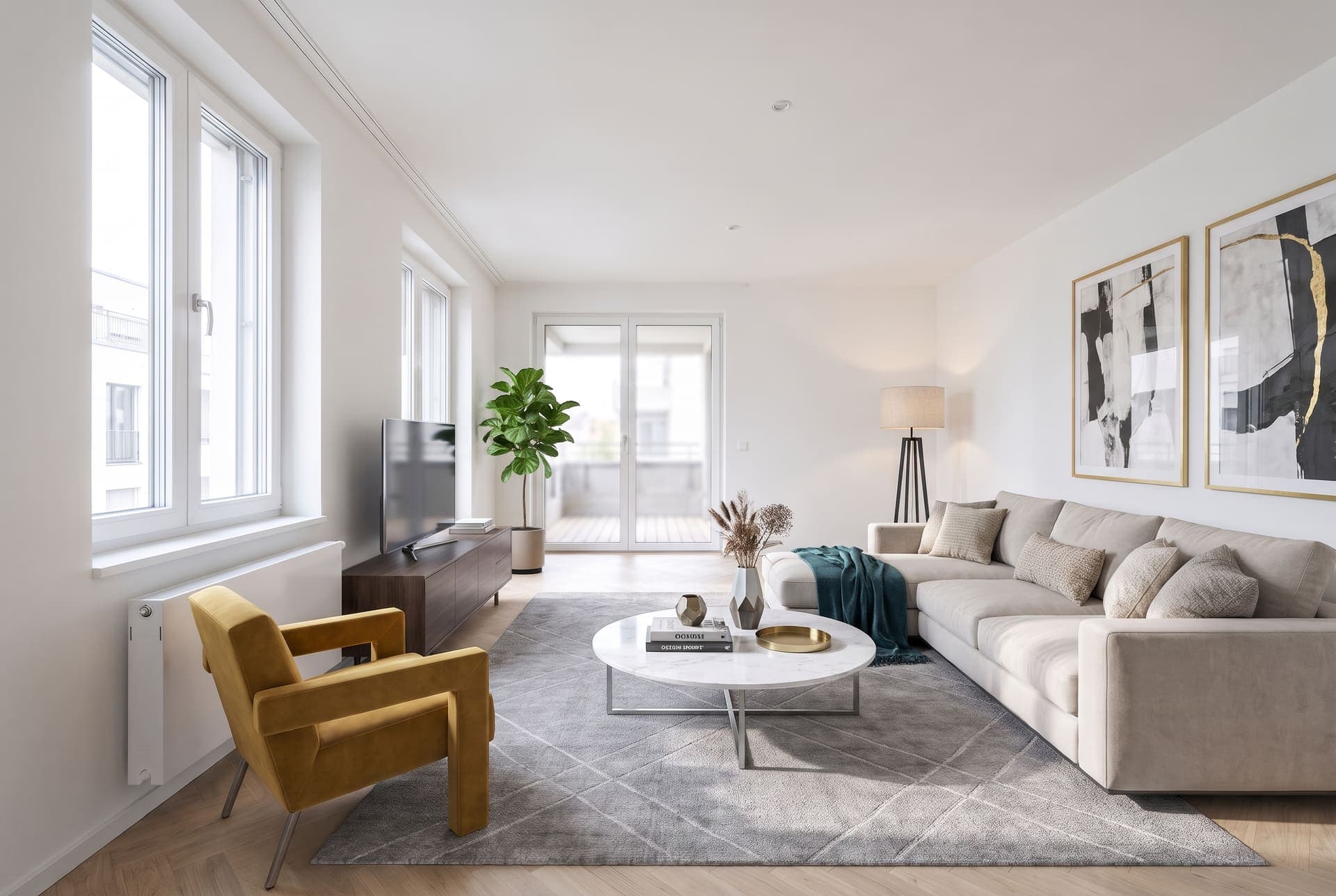
What home staging is, and what a stager does
Staging is not decorating for yourself. A decorator builds a home around the taste of the people who live in it. A stager does the opposite: the goal is a space that appeals to as many buyers as possible, which usually means neutral, bright and uncluttered.
In practice, a stager starts with a walk-through and a plan, then works room by room. Depending on the budget, the job can be a two-hour consultation or a full set of rented furniture, usually starting with the rooms buyers see first.
- A consultation: a walk-through with a list of what to remove, move or repaint.
- Rearranging and styling what you already own, from furniture layout to lamps, cushions and plants.
- Furniture and decor rental, delivered before the photos and picked up after the sale.
What home staging costs
Prices vary with the size of the home and the number of rooms, and they are quoted per property rather than per photo. According to the National Association of Realtors’ 2025 Profile of Home Staging, the median cost of using a staging service was $1,500, against $500 when the seller’s agent staged the home personally. That is a survey median, so your quote can sit well above or below it.
Redfin’s guide to staging costs, published in December 2025, gives an average of $1,800 with a range from $600 to $4,000. It lists a design consultation at $150 to $600 and furniture rental at $500 to $600 per room, and says rental can reach $2,000 depending on how many rooms you stage. For virtual staging, it quotes $39 to $199 per room.
When you compare quotes, ask how long the furniture rental lasts and what a renewal costs. A staged home that stays on the market longer than planned keeps running up the rental.
What staging changes for buyers, and what the evidence says
The honest answer is that staging helps buyers read a home, and the evidence on price and speed is based on opinions, not guarantees. In the same NAR report, 29% of agents reported a 1% to 10% increase in the dollar value offered for staged homes. Among sellers’ agents, 49% said staging reduced the time a home spends on the market.
Look at how the report words the effect on buyers: 26% of buyers’ agents said staging affects most buyers’ views, while 60% said it affects some buyers but not always. Those are agents’ perceptions, not measured results, and they say nothing about your house in particular.
SeLoger, a French property portal, makes the same point in a home staging guide updated in May 2024: staging improves how a home is presented, but it does not justify an inflated asking price. Correct pricing comes first, and staging supports it.
Simple staging tips that work in any home
You do not need a stager to get most of the benefit. Start with these steps, in this order, before anyone takes a photo.
- Declutter first: clear counters, shelves and floors, and store personal items such as family photos.
- Clean thoroughly, including windows, grout and light fittings.
- Let in light: open curtains, replace dead bulbs and use warm white bulbs throughout.
- Go neutral: fresh paint in a soft, light shade removes distractions and makes rooms feel larger.
- Make the entrance count: a tidy hall, a clean door and a clear path set the tone.
- Give each room one job: a bedroom that is a bedroom, an office that is an office.
- Put your effort into the rooms that matter most. In NAR’s 2025 report, buyers’ agents ranked the living room first (37%), then the primary bedroom (34%) and the kitchen (23%).
Physical or virtual staging: when each one fits
Physical staging has a real advantage: buyers can walk through a furnished home, sit on the sofa and feel the proportions of each room. For a high-end property, or when many visits are expected, that experience is hard to replace.
Virtual staging works on the photos instead. An empty room is furnished digitally, so the listing shows how the space can be used, without delivery, rental or a staging window before the shoot. It also lets you try a style and change your mind. It is a strong fit for vacant properties, for homes that cannot be furnished in time, and for agents with many listings.
The two are not exclusive. Some sellers stage the main rooms for real and use virtual staging on the rest, or only on the photos.
Trying the virtual option
Stagova is an AI virtual staging tool for listing photos. It furnishes an empty room in one of six styles (modern, scandinavian, industrial, bohemian, classic or minimalist) and is designed to leave the walls, windows, floors and camera angle as photographed. It also empties a furnished room and improves light and color.
One credit is one photo, whatever the transformation. New accounts get 10 free credits, no card needed. Packs start at $12 for 25 photos, and the biggest pack brings it down to $0.25 a photo. There is no subscription, credits never expire, and a photo that fails is refunded automatically.